15 Easy Scenery Drawing For Kids Oil Pastel Color | Creative Ideas
Easy scenery drawing for kids with oil pastel color is a fun way to introduce children to landscapes, color blending, simple shapes, and creative composition. Oil pastels are especially useful for young artists because their strong pigments can create bright colors without requiring complicated painting techniques.
Children can use basic lines and shapes to draw the sun, mountains, trees, houses, rivers, clouds, flowers, and other scenery elements. The following ideas are designed to be simple enough for beginners while still encouraging children to experiment with color.
Easy Nature Scenery Drawings:
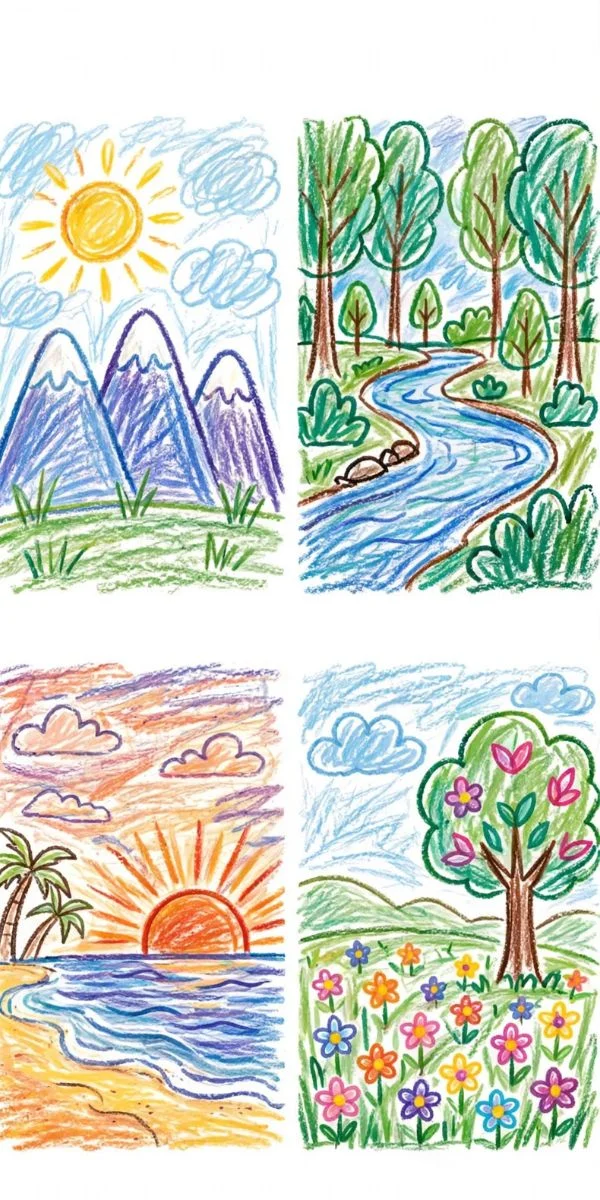
1. Sunny Mountain Landscape
A mountain landscape is one of the easiest scenery drawings for children. It requires only a few large shapes and bright colors.
Oil Pastel Details
Start with a blue sky and draw two or three simple mountain shapes underneath. Use green for the lower slopes and darker colors for some shadows. Add a yellow sun, white clouds, and a green foreground. Blend light and dark green gently to give the hills more depth.
2. River Between Mountains
Create a peaceful landscape with a winding river flowing between mountains.
Oil Pastel Details
Draw the mountains first using triangular or curved shapes. Color them green, brown, or purple. Leave a winding section through the middle for the river and fill it with blue oil pastel. Add trees along both sides and use white or light-blue strokes to suggest reflections.
3. Simple Sunset Scenery
A sunset scene is excellent for teaching children how to blend warm colors.
Oil Pastel Details
Color the upper sky with orange, yellow, pink, and red. Blend the colors horizontally while they are still on the paper. Draw dark hills or trees in the foreground and place a bright yellow-orange sun near the horizon.
4. Green Valley Scenery
A simple valley can be created using curved hills instead of complicated details.
Oil Pastel Details
Use several shades of green for the hills and add a blue sky above them. A narrow path can lead from the foreground toward the center of the picture. Add small trees, flowers, and clouds to make the scenery more lively.
5. Waterfall Landscape
A waterfall provides children with an opportunity to experiment with white and blue oil pastel strokes.
Oil Pastel Details
Draw tall green or brown cliffs with a waterfall flowing down the center. Use light blue and white for the falling water. Add rocks, bushes, and small plants around the bottom to complete the scene.
Easy Seasonal Scenery Drawings:
6. Spring Garden Scenery
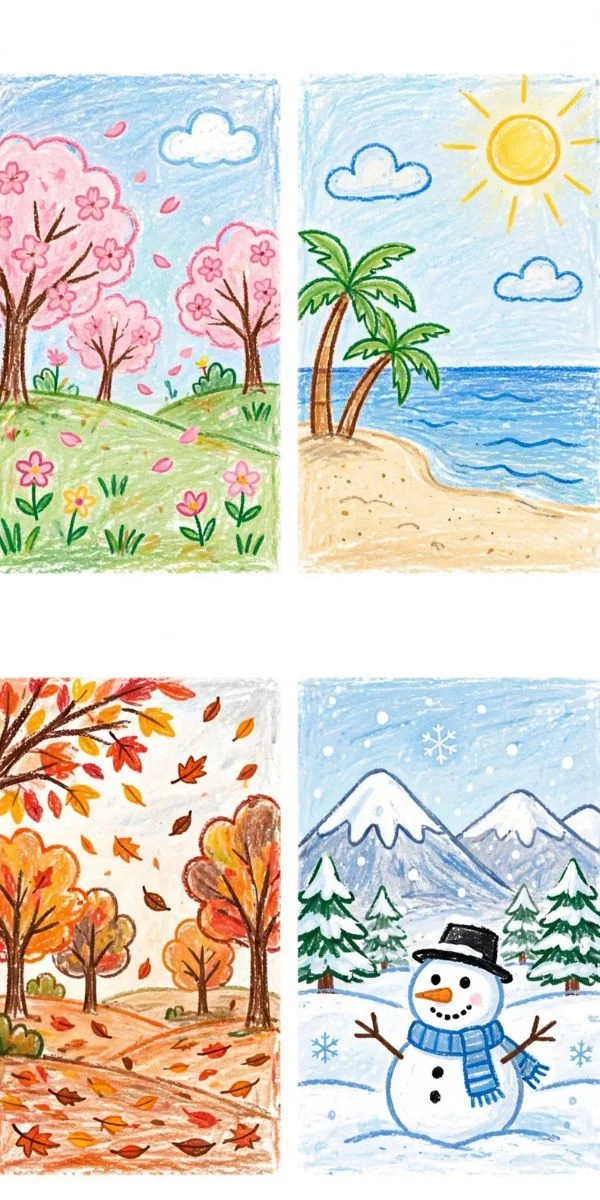
A colorful spring garden can be created using simple flowers and green grass.
Oil Pastel Details
Begin with a light-blue sky and fluffy white clouds. Draw green grass across the bottom and add flowers in pink, yellow, purple, and red. Children can use short oil pastel strokes to create flower petals instead of drawing complicated shapes.
7. Autumn Tree Scenery
An autumn landscape gives children a chance to explore warm colors.
Oil Pastel Details
Draw one or two trees with brown trunks and branches. Use orange, red, yellow, and brown oil pastels for the leaves. Instead of coloring every leaf individually, children can make small dots and short strokes around the branches.
8. Winter Snowy Village
A snowy village can be simplified into a few houses surrounded by snow-covered trees.
Oil Pastel Details
Use pale blue or white for the snowy ground. Draw small houses with colorful roofs and windows. Add evergreen trees using green and white, then use light-blue strokes to create shadows in the snow.
9. Summer Beach Scenery
A beach scene is easy to draw using large areas of blue, yellow, and green.
Oil Pastel Details
Color the sky light blue and add a bright yellow sun. Use yellow or tan for the sand and blue for the ocean. Add simple waves with white oil pastel and draw a palm tree using brown and green.
Easy Imaginative Scenery Drawings:
10. Little House in the Hills
A small house surrounded by hills creates a charming beginner-friendly landscape.
Oil Pastel Details
Draw a simple square house with a triangular roof. Use bright colors for the walls and roof. Surround it with green hills, trees, flowers, and a blue sky. A narrow pathway leading toward the house can make the composition more interesting.
11. Forest Path Scenery
A path through a forest teaches children how to create the impression of distance.
Oil Pastel Details
Draw larger trees near the sides of the paper and smaller trees toward the center. Create a winding path using brown or beige. Use darker greens near the foreground and lighter greens farther away.
12. House Beside a River
Combine a simple home, water, trees, and hills into one easy landscape.
Oil Pastel Details
Place a small house on one side of the paper and draw a blue river flowing beside it. Add green trees, distant hills, clouds, and flowers. White highlights along the river can suggest sunlight reflecting on the water.
13. Village Road Scenery
A countryside road can become the main feature of a simple scenery drawing.
Oil Pastel Details
Draw a road beginning wide at the bottom and becoming narrower toward the horizon. Add houses, trees, fences, and fields on both sides. Use green, yellow, brown, and blue to create a warm rural scene.
14. Moonlit Mountain Scenery
This simple night landscape allows children to work with darker colors and bright highlights.
Oil Pastel Details
Use dark blue, purple, and black for the sky and mountains. Add a large yellow or white moon and a few stars. White or pale-blue oil pastel can highlight the mountain edges and create a soft nighttime effect.
15. Rainbow Landscape
A rainbow landscape is colorful, cheerful, and easy for children to customize.
Oil Pastel Details
Draw a large rainbow across a blue sky and fill each curved band with a different color. Add green hills, flowers, clouds, a small house, or trees underneath. Children can choose their own rainbow arrangement while practicing smooth curved lines.
Basic Oil Pastel Techniques for Kids:

Oil pastels can be used in several simple ways. Children can make broad strokes for large areas, use the edge of a pastel for thin lines, and layer different colors to create richer shades.
For blending, place two colors next to each other and gently rub them together with a finger or suitable blending tool. Younger children should be guided when using their fingers and should wash their hands afterward.
How to Draw a Simple Scenery Composition
Encourage children to start with the largest shapes first. A useful order is the sky, distant mountains or hills, middle-ground objects, and foreground details.
Keeping larger objects near the bottom and smaller objects toward the horizon can help create a basic sense of distance without requiring complicated perspective rules.
Choosing Oil Pastel Colors
A basic set can be enough for many scenery drawings. Useful colors include:
- Sky blue
- Dark blue
- White
- Yellow
- Orange
- Red
- Pink
- Light green
- Dark green
- Brown
- Black
- Purple
Children can mix or layer these colors to create additional shades.
Tips for Better Oil Pastel Scenery Drawings
Use thicker paper when possible because oil pastels can become heavy when several layers are applied. Encourage children to press lightly at first and add stronger color gradually.
White oil pastel is particularly useful for clouds, snow, water reflections, and highlights. Dark colors can be added later to define trees, mountains, buildings, and other foreground elements.
Easy Ways to Add Texture
Children can create grass using short upward strokes, tree leaves using small dots, water using horizontal lines, and clouds using soft rounded strokes.
They can also scratch through a darker layer to reveal a lighter color underneath, creating a simple texture effect. This technique should be done gently to avoid damaging the paper.
FAQs About Easy Scenery Drawing for Kids With Oil Pastel Color
Which scenery is easiest for kids to draw?
Simple mountains, sunsets, rivers, beaches, gardens, and houses are good starting points because they can be created from basic shapes and lines.
Are oil pastels good for children’s scenery drawings?
Yes. Oil pastels provide strong color and allow children to make both broad strokes and small details. They are especially useful for colorful landscape projects.
What paper should kids use for oil pastels?
A thicker drawing or mixed-media paper is generally more suitable than very thin paper, especially when children plan to layer several colors.
How can kids blend oil pastels?
Place two colors next to each other and gently overlap or rub the edges together. Children can also layer one color over another to create gradual transitions.
What colors are useful for easy scenery drawing?
Blue, green, yellow, orange, red, brown, white, black, and purple can cover many beginner landscape projects. Additional shades can be created through layering.
Can children draw scenery without sketching first?
Yes. Some children may enjoy directly using oil pastels to create large shapes. For beginners who want more control, lightly sketching the main composition with a pencil first can make the process easier.