
20 Art Ideas Painting | Creative & Easy Painting Projects
Painting is one of the most flexible forms of art because a single color can be applied in countless ways. Brushes, sponges, fingers, cotton swabs, natural materials, and even recycled objects can create completely different marks and textures.
These art ideas painting projects explore a range of techniques, from simple watercolor experiments to textured acrylic artwork and abstract compositions. They can be adapted for beginners, children, classrooms, craft sessions, or anyone looking for a fresh painting idea.
Watercolor Painting Ideas:

Watercolor is known for its transparent appearance and ability to create soft layers. It is especially useful for experimenting with color blending and delicate details.
1. Watercolor Sunset
Paint a simple sunset using bands of yellow, orange, pink, purple, and blue. Blend the colors while they are still slightly wet to create a gradual transition.
Add a dark silhouette of mountains, trees, birds, or buildings after the background dries.
Fact: Watercolor paint is typically transparent or semi-transparent because pigment is suspended in a water-based binder, allowing the paper to influence the appearance of the color.
2. Loose Watercolor Flowers
Instead of carefully outlining each flower, use loose brushstrokes to suggest petals and leaves.
Try several flower shapes on one page and allow the colors to overlap naturally.
3. Watercolor Galaxy
Cover the paper with dark blue, purple, and black watercolor. While the surface is still damp, add lighter colors in selected areas.
Once dry, add small white dots for stars.
Use heavier watercolor paper when possible because very wet techniques can cause lightweight paper to buckle.
4. Watercolor Rainy Window
Create a pale background and then add darker vertical and diagonal marks to suggest rain on glass.
Paint a blurry landscape behind the imagined window for a soft atmospheric effect.
Acrylic Painting Ideas:
Acrylic paint can create opaque layers and is suitable for a wide variety of surfaces designed for painting.
5. Abstract Acrylic Blocks
Divide a canvas into irregular sections and fill them with contrasting colors.
Add thin lines, dots, or smaller shapes over the larger color fields once the first layer dries.
6. Minimalist Moon Painting
Paint a simple dark background and add a large moon using white, cream, or pale yellow.
Experiment with a perfectly round moon or a partially visible crescent.
Add only a few trees, birds, or stars so the composition remains uncluttered.
7. Acrylic Ocean Waves
Use several shades of blue, turquoise, white, and a small amount of darker color to create layers of waves.
Short curved brushstrokes can suggest movement across the water.
8. Colorful Mountain Landscape
Paint overlapping mountain shapes using different shades.
Make distant mountains lighter and less detailed while using stronger colors for the foreground.
This creates a simple sense of depth without requiring realistic perspective.
Texture Painting Ideas:
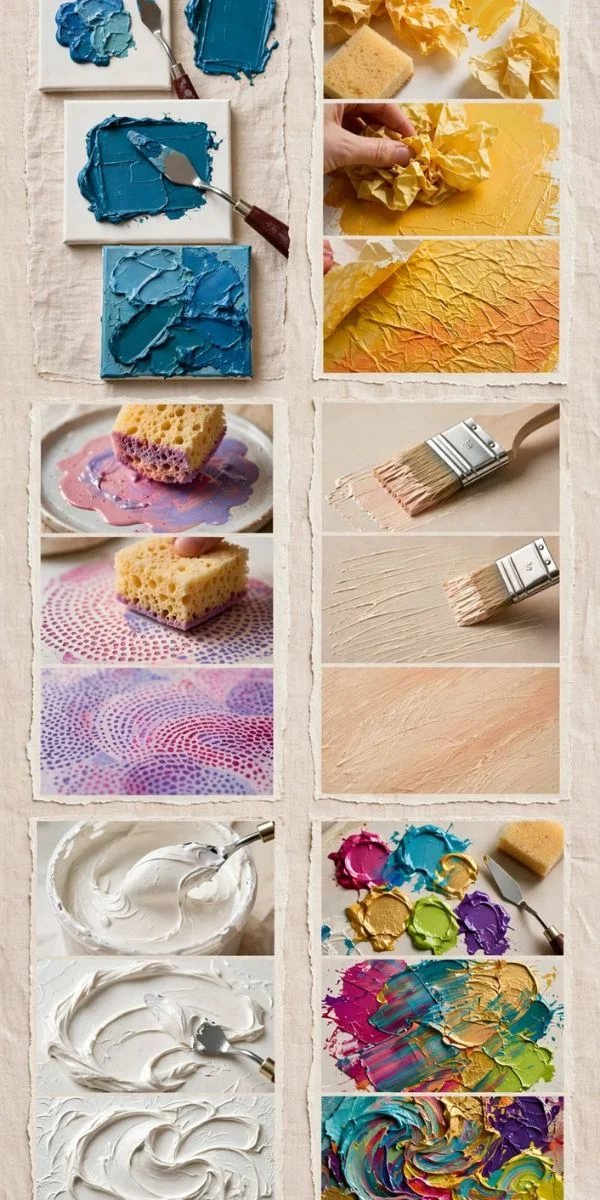
Texture can make a painting more tactile and visually interesting. Different tools can produce marks that brushes cannot easily replicate.
9. Sponge Texture Painting
Apply paint to a sponge and lightly press it onto paper or canvas.
Layer several colors to create clouds, foliage, stone, flowers, or abstract backgrounds.
10. Palette Knife Abstract Art
Use a palette knife to spread acrylic paint across a suitable surface.
Drag, scrape, layer, and overlap different colors to create raised marks and sharp edges.
Fact: A palette knife can distribute paint differently from a brush because its rigid surface can push and spread thicker paint across the painting surface.
11. Salt and Watercolor Texture
Paint a small area with wet watercolor and sprinkle salt over it.
Allow the artwork to dry completely before gently removing the salt.
The resulting pattern can work especially well for backgrounds, snowy scenes, or abstract pieces.
12. Sand Texture Painting
Mix a small amount of clean, suitable fine sand into paint to create a textured surface.
Apply it to a sturdy painting surface and allow it to dry thoroughly.
Use appropriate safety precautions and avoid loose particles around very young children.
Nature-Inspired Painting Ideas:

Nature offers endless subjects for painting, from leaves and flowers to skies and landscapes.
13. Botanical Leaf Painting
Choose a leaf as a reference and paint its overall shape, veins, and color variations.
Instead of making a perfectly realistic copy, exaggerate certain colors or simplify the details for a more artistic result.
14. Sunset Tree Silhouette
Create a warm sunset background using blended colors.
After it dries, paint a dark tree silhouette across the foreground.
The strong contrast between the bright background and dark foreground makes this project visually striking without complicated details.
15. Painted Flower Garden
Fill a canvas with flowers using different brush sizes.
Try large flowers in the foreground and smaller ones farther away. Mix upright stems, curved stems, leaves, and tiny dots to create variety.
16. Ocean and Seashell Painting
Paint a coastal scene using blue, turquoise, cream, and sandy tones.
Add simplified seashells, waves, rocks, or a distant horizon.
If using real shells as part of the artwork, clean and dry them thoroughly first.
Experimental Painting Techniques:

Experimental painting focuses on discovering what happens when paint is moved, layered, mixed, or applied in an unusual way.
17. String Pull Painting
Dip a piece of string into paint and place it onto one side of folded paper. Close the paper and gently pull the string outward.
Open the paper to reveal the mirrored paint pattern.
Try several colors separately to create different shapes.
18. Pour Painting
Pour small amounts of fluid paint onto a prepared surface and allow the colors to move across one another.
Tilt the surface gently to influence the direction of the paint.
This technique can produce flowing abstract patterns, but it requires a protected workspace and careful cleanup.
19. Blow Painting
Place a small amount of diluted paint onto paper and use a straw to move the paint outward.
The resulting lines can resemble branches, coral, fireworks, or abstract forms.
For young children, an adult should supervise closely and use safer alternatives if there is any concern about accidentally inhaling the paint.
20. Bubble Print Painting
Create colorful bubbles using an appropriate paint-and-bubble mixture and gently place paper over the bubbles.
The paper can capture overlapping circular patterns.
Allow each layer to dry before adding another color for a more complex effect.
How to Make Painting Projects More Creative
A painting becomes more personal when the artist changes something rather than following a fixed formula.
Experiment With Brushstrokes
Try thick strokes, thin strokes, dry-brush marks, dots, dashes, curved lines, and sweeping movements.
Using the same paint color with different brush techniques can produce surprisingly different results.
Change the Color Palette
Instead of always using realistic colors, choose a specific palette.
Try monochromatic blues, warm sunset shades, pastel colors, earthy neutrals, or bold complementary colors.
Combine Painting Techniques
A background can be created with watercolor while details are added with acrylic or another suitable medium.
You can also combine brush painting with sponge printing, palette-knife marks, or controlled splattering.
Painting Ideas for Different Skill Levels
Painting activities can be adjusted depending on experience.
Beginner-Friendly Projects
Simple sunsets, abstract color blocks, sponge painting, moon paintings, and flower gardens are good starting points because they do not require highly detailed drawing.
More Advanced Experiments
Palette-knife paintings, layered landscapes, pour painting, botanical studies, and mixed-technique artwork provide more opportunities to experiment with composition and texture.
Choosing the Right Painting Surface
The surface can affect how paint behaves.
Paper
Watercolor paper is particularly useful for water-based techniques because it is designed to handle more moisture than ordinary printer paper.
Canvas
Canvas is commonly used with acrylic and oil paints. It provides a sturdy surface for layered or textured artwork.
Recycled Surfaces
Clean cardboard can work for many craft-painting projects. However, very wet techniques may soften or warp thin cardboard.
Basic Painting Supplies
A simple collection does not need to contain dozens of specialized tools.
Useful supplies include:
- Watercolor or acrylic paint
- Brushes in several sizes
- Watercolor paper or suitable painting surfaces
- Palette or mixing tray
- Water container
- Paper towels
- Sponges
- Pencil for light sketches
- Protective table covering
- Apron or old clothing
Choose materials according to the artist’s age and the painting technique.
Painting Safety and Cleanup
Use paints according to their labels and choose age-appropriate, non-toxic products for children’s activities.
Protect tables and floors before beginning messy techniques. Keep paint containers closed when they are not being used and wash brushes soon after painting so dried paint does not permanently harden on them.
For Children’s Painting
Young children should be supervised throughout painting activities. Avoid giving them materials that are unsuitable for their age, and do not assume that a product is safe simply because it is commonly used for crafts.
FAQs About Art Ideas Painting
What are some easy painting ideas for beginners?
Sunsets, abstract color blocks, sponge painting, simple flowers, moon scenes, and basic landscapes are excellent beginner projects. They allow experimentation without requiring advanced drawing skills.
What is the easiest painting technique to learn?
Simple brush painting is a good starting point because it requires only paint, a suitable surface, and a brush. Sponge printing and other experimental techniques can then be introduced for variety.
Which paint is best for art projects?
The best paint depends on the project. Watercolor works well for transparent washes, while acrylic is useful when you want stronger, opaque layers on suitable surfaces.
How can I make a painting look more interesting?
Use multiple textures, vary brushstrokes, layer colors, introduce contrast, or combine painting techniques. Changing the scale of objects can also make a familiar composition more interesting.
What are good painting ideas for children?
Sponge painting, large brush painting, simple flower designs, rainbow painting, handprint art, and basic nature scenes can be adapted for children. Always choose age-appropriate materials and provide supervision.
How do I prevent watercolor paper from warping?
Using heavier watercolor paper can help when working with substantial amounts of water. For very wet techniques, artists may also secure the paper to a suitable surface before painting.
Can I paint on cardboard?
Yes, clean and sturdy cardboard can be used for many painting projects. It is especially useful for craft painting and recycled-art projects, although excessive moisture can cause thin cardboard to bend.
What can I use instead of a paintbrush?
Depending on the project, you can experiment with sponges, cotton swabs, palette knives, suitable natural materials, cardboard edges, or other clean tools that create interesting marks.
How can I create texture in a painting?
Try sponges, palette knives, salt with watercolor, thick paint, layered brushstrokes, or suitable textured materials. Different application methods change how the paint sits on the surface.
How long should a painting dry?
Drying time varies according to the paint, thickness of the layers, surface, temperature, and humidity. Thin watercolor washes can dry relatively quickly, while thick acrylic applications may require substantially more time.


