20 Clay For Jewelry | Creative DIY Accessories
Clay jewelry is a creative way to make personalized accessories such as earrings, necklaces, bracelets, rings, pendants, and charms. Depending on the material, clay can be shaped into delicate patterns, colorful geometric pieces, miniature flowers, abstract forms, and nature-inspired designs.
The most common materials for handmade clay jewelry include polymer clay, air-dry clay, and certain ceramic clay bodies. Polymer clay is particularly popular for jewelry because it remains workable until properly cured and can be conditioned, shaped, textured, and combined with different colors.
Small clay jewelry pieces can be finished with jewelry findings such as jump rings, earring hooks, posts, chains, clasps, and bracelet components. Below are 20 creative clay for jewelry ideas divided into four categories.
Clay Earrings:
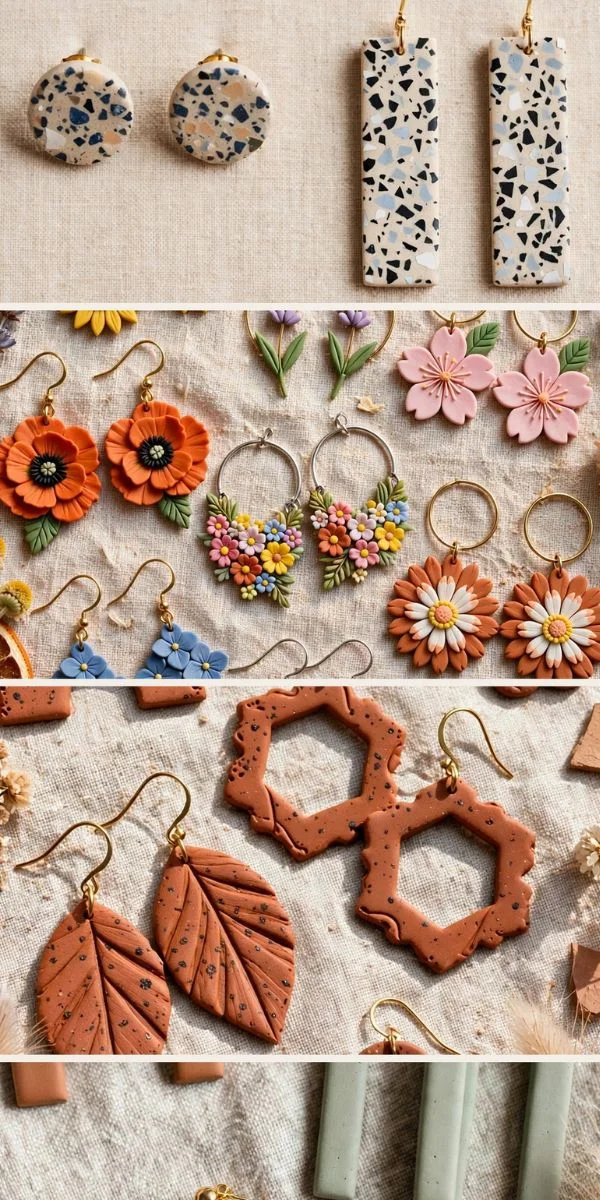
Earrings are among the most popular clay jewelry projects because small clay pieces can be shaped into many different silhouettes. Polymer clay is commonly used because it can produce lightweight pieces when rolled relatively thin.
1. Clay Stud Earrings
Small clay studs are a simple introduction to handmade jewelry. Create circles, squares, flowers, hearts, or other compact shapes and attach suitable earring posts after curing.
Neutral colors can create everyday accessories, while bright colors work well for statement looks.
2. Clay Hoop Earrings
Clay can be combined with metal hoops to create lightweight decorative earrings. Rather than making the entire hoop from clay, small clay shapes can be attached to or suspended from a metal hoop.
Leaves, geometric pieces, flowers, and abstract shapes are particularly suitable.
3. Clay Dangle Earrings
Dangle earrings allow more room for creative shapes. Layer two or three clay components to create movement while keeping the individual pieces relatively lightweight.
Long arches, moons, flowers, and geometric shapes can all work beautifully as dangle designs.
4. Clay Flower Earrings
Miniature flowers can be shaped from individually formed petals or created with simple stamped details.
Pastel shades give the earrings a delicate appearance, while bold red, yellow, or pink can create a stronger statement.
5. Clay Geometric Earrings
Circles, arches, triangles, rectangles, and irregular geometric shapes are easy to adapt into modern earrings.
Using two contrasting clay colors can emphasize the individual sections without requiring complicated decoration.
Clay Necklaces and Pendants:
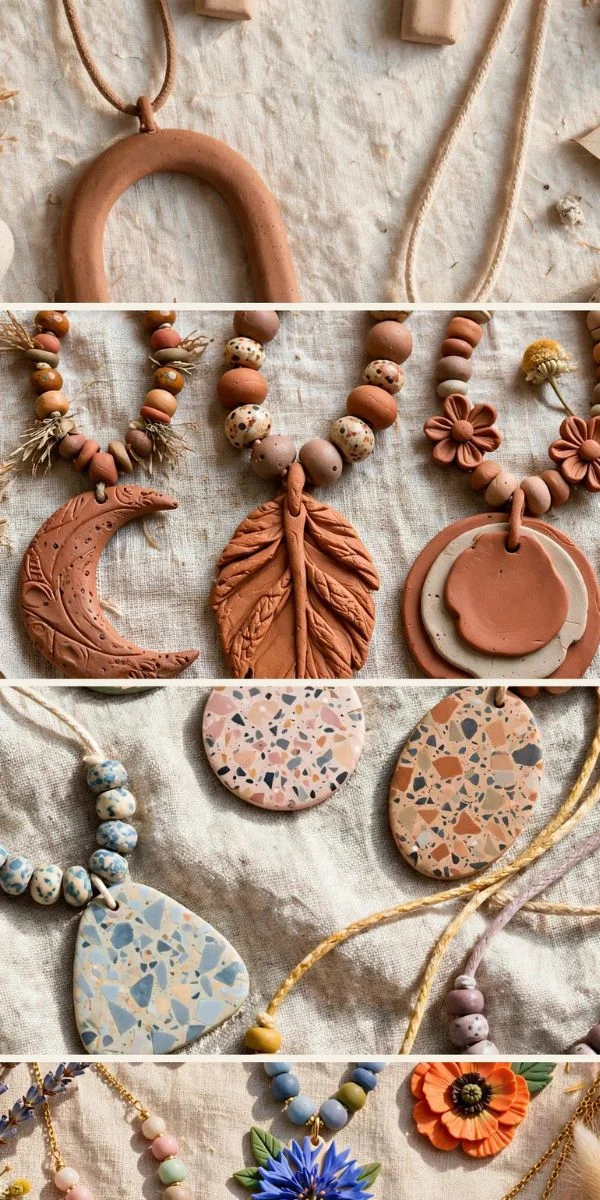
Clay pendants provide more surface area for decorative details while remaining relatively easy to customize.
6. Clay Heart Pendant
A clay heart can be used as a simple necklace pendant. Roll the clay evenly and cut or shape the heart before adding a small hole for the jewelry finding.
A glossy finish, stamped texture, or tiny painted detail can personalize the design.
7. Clay Moon Pendant
A crescent moon is a versatile shape for handmade necklaces. It can be left minimal or decorated with stars, dots, flowers, or textured impressions.
Gold, silver, navy, cream, and pastel colors can produce very different styles.
8. Clay Sun Pendant
A miniature sun pendant can feature a circular center surrounded by rays. Texture can be pressed into the surface before curing.
Yellow, orange, terracotta, and gold-toned finishes work especially well for a warm jewelry aesthetic.
9. Clay Floral Pendant
Floral pendants can be made using small petals arranged around a central detail. A simple flower silhouette can also work for a minimalist necklace.
A small hole should be positioned carefully so the pendant hangs correctly from the chain.
10. Clay Initial Pendant
An initial pendant can be personalized with a letter representing a name or meaningful word. Letters can be cut from a thin clay sheet or created using a suitable mold.
A simple letter design can be paired with a small charm or bead for additional detail.
Clay Rings and Bracelets:
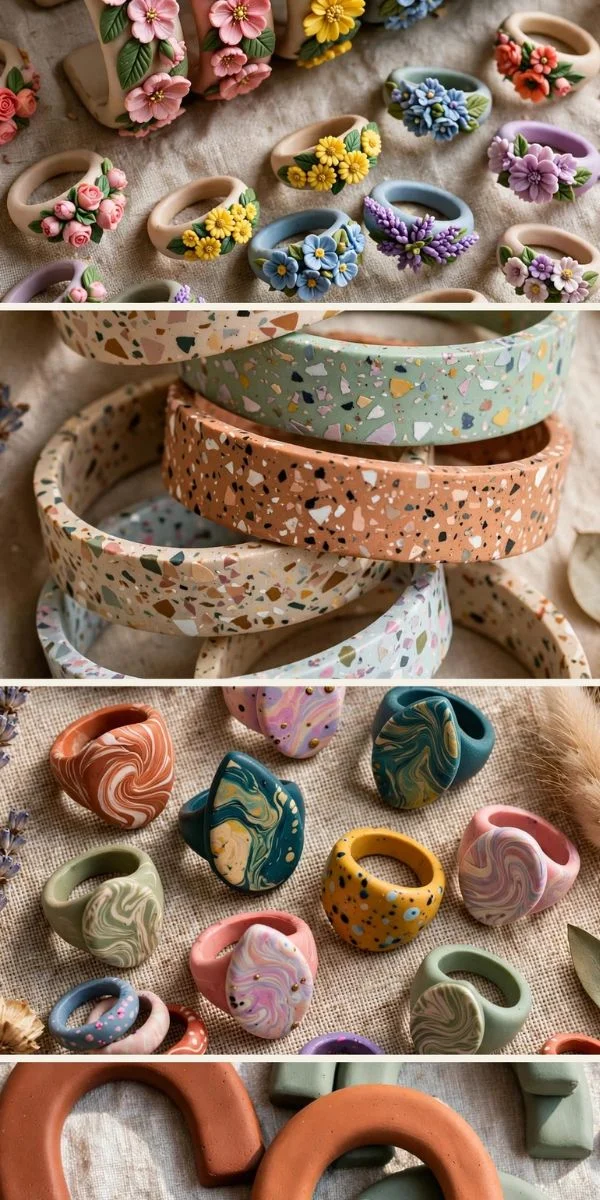
Rings and bracelets require attention to size because the finished pieces need to fit comfortably and maintain their shape during use.
11. Clay Statement Ring
A clay statement ring can feature an oversized oval, flower, geometric shape, or abstract centerpiece.
For polymer clay, make sure the ring structure is properly cured and avoid making the band unnecessarily thin.
12. Clay Minimalist Ring
Minimalist rings can be made with a narrow clay band and a tiny decorative element.
Simple neutral colors such as white, beige, black, brown, or muted pink create an understated appearance.
13. Clay Beaded Bracelet
Small clay beads can be shaped into round, oval, square, or irregular forms and threaded onto elastic cord or suitable jewelry string.
Mixing clay beads with wooden, glass, or metal beads can create additional texture.
14. Clay Charm Bracelet
Create several tiny clay charms representing hearts, stars, flowers, moons, fruits, or animals. Attach them to a bracelet chain using small jump rings.
Using several miniature designs makes the bracelet feel more personalized.
15. Clay Cuff Bracelet Details
Instead of creating a complete clay cuff, clay decorative elements can be attached to a suitable bracelet base.
This approach can make the accessory easier to wear while still providing the visual effect of handmade clay decoration.
Nature, Abstract, and Miniature Clay Jewelry:
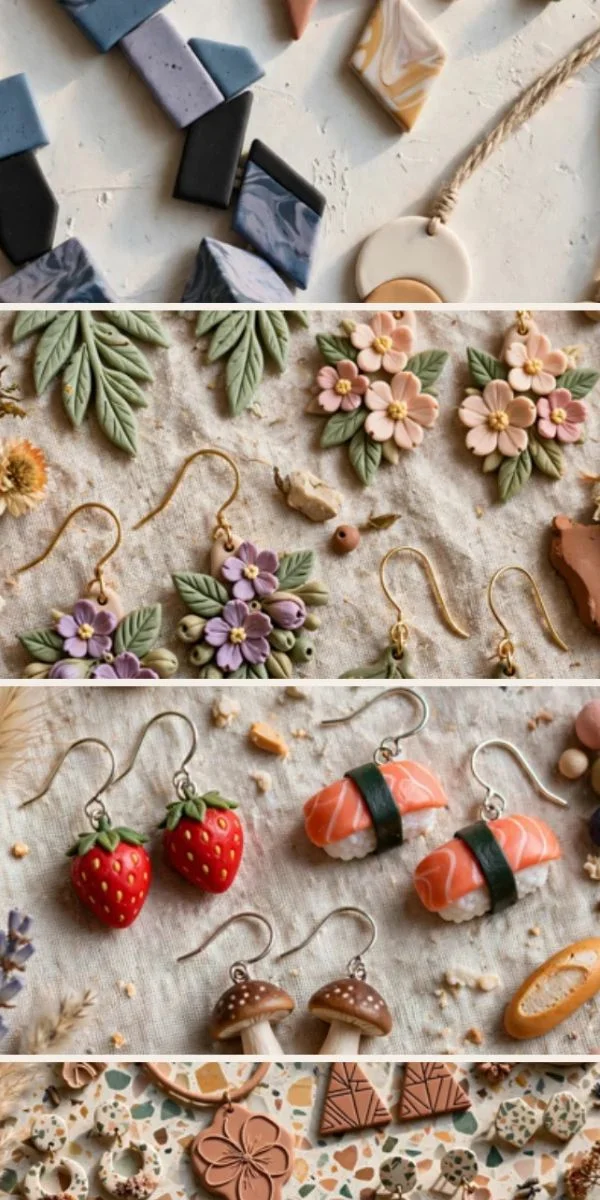
This category is ideal for experimenting with colors, textures, and unusual shapes.
16. Clay Leaf Jewelry
Leaf-shaped clay pieces can become earrings, pendants, or bracelet charms. Press real leaves or suitable texture tools gently into the clay to create natural-looking veins.
Green, brown, gold, and earthy colors emphasize the botanical theme.
17. Clay Mushroom Jewelry
Miniature mushrooms can become playful earrings, charms, or pendants. Create a rounded cap and narrow stem, then add small dots or texture.
Red-and-white creates a classic mushroom appearance, while neutral tones can make the design more subtle.
Read Next: 30 Fall Clay Magnets
18. Clay Marble Jewelry
Marbled clay is created by combining different colored pieces without completely blending them together.
White with black, pink with cream, or blue with white can create distinctive patterns. The marbled effect can be used for earrings, pendants, and beads.
19. Clay Terrazzo Jewelry
Terrazzo-style clay jewelry uses small contrasting pieces distributed through a base color. After the clay is shaped and cured, the tiny fragments create a speckled decorative effect.
This technique works particularly well for flat earrings and geometric pendants.
20. Clay Abstract Jewelry
Abstract jewelry does not need to represent a specific object. Combine curved lines, irregular shapes, arches, dots, and layered clay pieces to create original designs.
Experimenting with different proportions and color combinations can produce modern handmade accessories without requiring complex sculpting skills.
Choosing Clay for Jewelry
Polymer clay is one of the most practical materials for handmade clay jewelry because it can be formed into thin, lightweight pieces and cured in a home oven according to the manufacturer’s instructions.
Air-dry clay can also be used for decorative jewelry, but the finished pieces may be more vulnerable to moisture and impact depending on the specific product.
Traditional ceramic clay requires kiln firing. It can produce beautiful jewelry components, but the additional firing process makes it less convenient for simple home jewelry projects.
How to Make Clay Jewelry
Start by conditioning or preparing the clay according to the material’s instructions. Roll it to an even thickness and cut or shape your chosen design.
Add texture, holes, patterns, or layered pieces while the clay is still workable. For earrings and pendants, make sure holes are positioned correctly before curing.
Cure or dry the pieces according to the clay manufacturer’s instructions. Afterward, attach jewelry findings such as posts, hooks, jump rings, chains, or cords.
Clay Jewelry Design Tips
Keep earrings and pendants lightweight, particularly if they will be worn for several hours. Thin, evenly rolled clay can help reduce unnecessary weight.
Use a consistent thickness when making pairs of earrings. Matching pieces should be similar in size and shape so they look balanced when worn.
Test color combinations on small scraps before committing to a complete jewelry set. Some colors can change slightly during curing or finishing.
Finishing Clay Jewelry
Some polymer clay jewelry can be left with its natural cured finish, while other designs may benefit from a compatible varnish or glaze specifically recommended for the clay.
Avoid applying random coatings without checking compatibility. Certain finishes can remain sticky or react with polymer clay.
For ceramic clay jewelry, the final surface depends on the clay body, glaze, and firing process.
Jewelry Findings for Clay Designs
Common findings include earring posts, hooks, jump rings, chains, clasps, elastic cords, pendant bails, and heains.
The finding should be appropriate for the jewelry design and securely attached. For pieces intended for regular wear, periodically check connections for signs of loosening or damage.
Frequently Asked Questions
What clay is best for jewelry?
Polymer clay is a popular choice for handmade jewelry because it is workable, can be formed into lightweight designs, and can be cured in an oven according to the manufacturer’s instructions.
Can you make jewelry with air-dry clay?
Yes. Air-dry clay can be used for decorative earrings, pendants, beads, and charms. However, its durability and moisture resistance vary by product.
Is polymer clay good for earrings?
Yes. Polymer clay is widely used for earrings because relatively thin pieces can be lightweight while still supporting detailed shapes and patterns when properly cured.
How thick should clay jewelry be?
There is no single thickness for every design. It should be thick enough to maintain its shape but thin enough to remain comfortable, especially for earrings. Follow the clay manufacturer’s guidance for the material being used.
Can clay jewelry get wet?
The answer depends on the clay and finish. Many polymer clay pieces tolerate occasional moisture better than untreated air-dry clay, but prolonged exposure to water can affect some finishes and jewelry components.
How do you attach earring posts to clay?
The clay should first be properly cured. Then use an adhesive appropriate for the clay and the metal finding, following the adhesive manufacturer’s instructions.
Can clay jewelry break?
Yes. Thin or poorly supported clay pieces can break if dropped, bent, or subjected to repeated impact. Proper curing and an appropriate design thickness can improve durability.
Can I make clay beads for jewelry?
Yes. Clay can be shaped into round beads, tubes, discs, cubes, flowers, hearts, and irregular forms. Make the stringing hole before curing or drying.
How do you make marbled clay jewelry?
Combine small pieces of two or more clay colors, twist or roll them together, and flatten them without completely blending the colors. The resulting pattern can then be cut into jewelry shapes.
Is clay jewelry waterproof?
Not all clay jewelry is waterproof. Polymer clay itself can tolerate some moisture after proper curing, but finishes, adhesives, and metal findings may have different water resistance.
Can clay jewelry be personalized?
Yes. Initials, names, birth-inspired colors, flowers, symbols, dates, and custom shapes can all be incorporated into clay jewelry designs.
How do you store handmade clay jewelry?
Store pieces in a clean, dry place where they will not be crushed or scratched. Keep delicate earrings and thin components separated from heavier jewelry.