20 Embroidery Bracelets | DIY Designs for Beginners
Embroidery bracelets are a creative way to combine colorful thread, simple stitching, and wearable art. They can be made with embroidery floss, fabric strips, beads, charms, or recycled materials, making them suitable for beginners and experienced crafters. From delicate floral bands to bold geometric designs, there are many ways to create a bracelet that feels personal and unique.
These 20 embroidery bracelets are divided into four categories to make it easier to choose a style. You can experiment with different stitches, color combinations, textures, and closures to create handmade bracelets for yourself, friends, birthdays, festivals, or handmade gift collections.
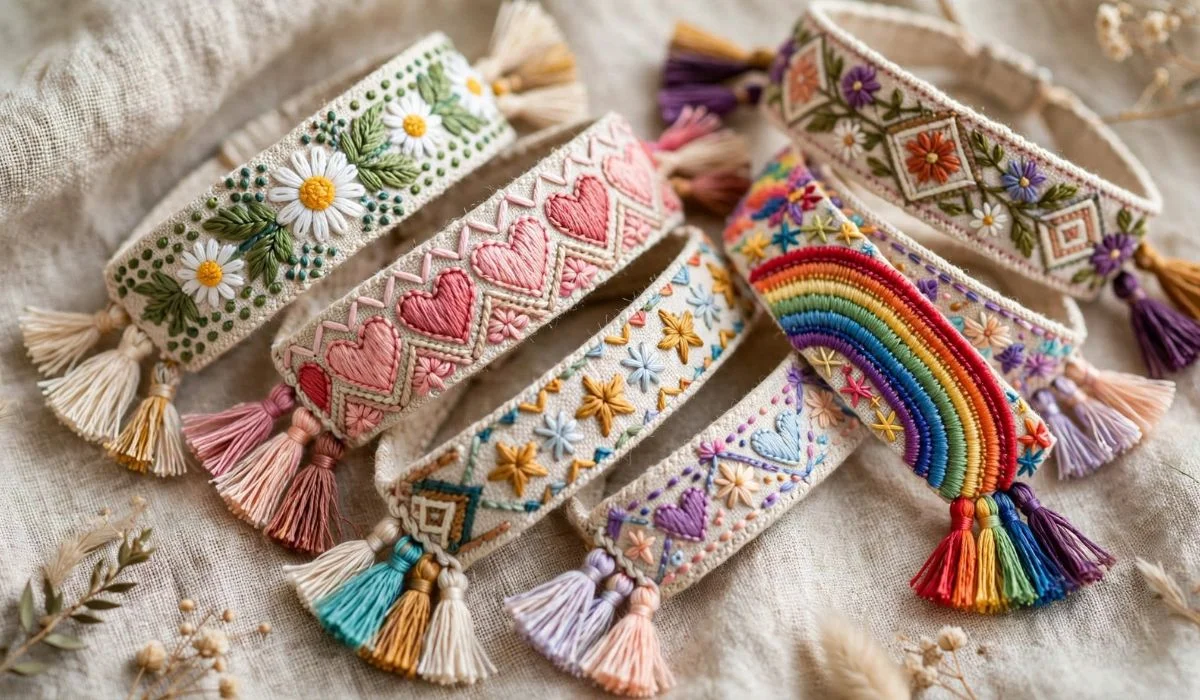
Floral and Nature-Inspired Embroidery Bracelets
1. Tiny Wildflower Bracelet
Create a delicate bracelet featuring tiny embroidered flowers scattered across a narrow fabric band. Use small French knots for flower centers and simple lazy-daisy stitches for petals.
Soft pink, lavender, yellow, and green threads create a gentle spring-inspired appearance. This design works especially well with a cream, beige, or light denim fabric base.
2. Embroidered Daisy Chain Bracelet
Make a continuous row of daisies around the bracelet using white thread for petals and yellow thread for centers. Add small green leaves between the flowers for extra detail.
A repeating daisy pattern is beginner-friendly because the same small motif can be stitched several times around the band.
3. Lavender Vine Bracelet
A lavender-inspired bracelet can use small purple stitches arranged along thin green stems. Combine straight stitches with tiny French knots to create the appearance of lavender flowers.
This design looks beautiful on neutral fabric and works well as a simple handmade accessory.
4. Botanical Leaf Bracelet
Instead of focusing on flowers, create a bracelet covered with embroidered leaves. Try satin stitches for larger leaves and stem stitches for the branches.
Use several shades of green to make the pattern look more natural. A few gold or brown stitches can add an earthy accent.
5. Mushroom Garden Bracelet
For something more playful, embroider tiny mushrooms, leaves, and dots around the bracelet. Use red, orange, cream, and green thread for a woodland-inspired color palette.
Small mushrooms can be arranged as repeating motifs or placed randomly to create a miniature garden effect.
Geometric and Modern Embroidery Bracelets
6. Geometric Diamond Bracelet
Create repeating diamonds using straight stitches or backstitches. Alternate two or three thread colors to produce a clean geometric pattern.
This bracelet is a good choice for someone who prefers modern accessories instead of traditional floral designs.
7. Checkerboard Thread Bracelet
A checkerboard bracelet can be made by creating small embroidered squares in alternating colors. Black and white produce a classic look, while pastel combinations create a softer style.
Keep the squares evenly spaced for a neat finished appearance.
8. Abstract Line Bracelet
Use curved lines, zigzags, loops, and short stitches to create an abstract embroidered design. There is no need for every section to be symmetrical.
Try combining contrasting colors with a neutral fabric background. This style is especially useful when you want to create an artistic bracelet without following a complicated pattern.
9. Embroidered Rainbow Bracelet
Create a narrow rainbow using several curved rows of colorful thread. You can use satin stitches for wider rainbow sections or simple backstitches for a minimal design.
Add tiny clouds at the ends for a cute version or leave the rainbow alone for a cleaner modern bracelet.
10. Minimalist Line-Art Bracelet
Choose one continuous line-art design, such as a heart, moon, star, face, or abstract shape. Stitch it repeatedly around the bracelet or place one larger motif in the center.
Black thread on white fabric gives the bracelet a simple contemporary appearance, while colored thread creates a more playful result.
Cute and Personalized Embroidery Bracelets
11. Initial Letter Bracelet
Personalize a bracelet with an embroidered initial. Use satin stitch for a bold monogram or backstitch for a delicate letter.
You can add tiny stars, dots, flowers, or hearts around the initial to make the design more decorative.
12. Tiny Heart Bracelet
Create a repeating pattern of small embroidered hearts around the bracelet. Red and pink are classic choices, but blue, purple, orange, or rainbow hearts can make the design more unusual.
Tiny hearts are easy to resize, making this pattern suitable for narrow or wide bracelets.
13. Friendship Quote Bracelet
Add a short word or phrase such as “besties,” “love,” “smile,” or “forever.” Choose a simple embroidery alphabet so the letters remain readable.
A short phrase works better than a long sentence because the bracelet has limited space.
14. Star and Moon Bracelet
Combine embroidered stars, crescent moons, and tiny dots for a celestial-inspired accessory. Dark blue, purple, silver, and gold threads can create a night-sky effect.
Use French knots for tiny stars and metallic thread for selected details.
15. Tiny Fruit Bracelet
Embroider miniature strawberries, cherries, lemons, oranges, or tiny apples around the bracelet. Each fruit can become a small repeating motif.
Use simple shapes rather than highly detailed fruit illustrations. This keeps the bracelet practical to stitch while giving it a colorful appearance.
Textured and Decorative Embroidery Bracelets
16. Beaded Embroidery Bracelet
Combine embroidery with small beads for extra texture. Stitch a simple floral, geometric, or dotted pattern first, then attach beads to selected sections.
Beads can highlight flower centers, geometric points, borders, or individual decorative motifs.
17. French Knot Texture Bracelet
Use French knots as the main design instead of simply using them for small details. Arrange the knots in clusters, waves, dots, or flower centers.
Different knot densities can create a textured bracelet that feels more dimensional than a flat embroidered pattern.
18. Ombre Thread Bracelet
Choose one color family and gradually move from light to dark shades. For example, use pale pink, medium pink, rose, and deep burgundy.
The ombre effect can be used for stripes, flowers, leaves, geometric shapes, or an abstract design.
19. Denim Embroidery Bracelet
Recycle a strip of old denim into a sturdy bracelet base. Decorate it with colorful embroidery using flowers, stars, initials, leaves, or abstract stitches.
Bright colors stand out particularly well against blue denim. You can finish the bracelet with a button closure or fabric ties.
20. Mixed-Stitch Statement Bracelet
Combine several embroidery stitches in one bold design. Try chain stitch for borders, satin stitch for larger shapes, French knots for texture, and backstitch for outlines.
A mixed-stitch bracelet is a great project when you want to practice multiple embroidery techniques while creating a wearable piece.
Basic Materials for Embroidery Bracelets
You do not need a large collection of supplies to make most embroidered bracelets. Start with embroidery floss, a needle, fabric, scissors, and a bracelet base.
Useful materials include:
- Embroidery floss
- Cotton or linen fabric
- Denim scraps
- Embroidery needle
- Small scissors
- Embroidery hoop
- Fabric marker
- Beads
- Small charms
- Buttons
- Thread or cord for closures
- Fabric glue when appropriate
Embroidery Stitches to Try
Different stitches can completely change the appearance of the same bracelet pattern.
Beginner-Friendly Stitches
Backstitch is useful for outlines, letters, and geometric designs. Running stitch creates simple lines and borders, while lazy-daisy stitch works especially well for flowers.
French knots are excellent for dots and textured details. Chain stitch can create decorative borders and curved patterns.
Choosing the Right Bracelet Base
A fabric strip is one of the easiest bases for embroidery because it provides a stable surface for stitching. Denim creates a stronger casual bracelet, while cotton gives a lighter and softer appearance.
For very narrow bracelets, keep your embroidery designs small. Large motifs may become difficult to stitch and may not remain recognizable once the bracelet is wrapped around the wrist.
How to Make an Embroidery Bracelet
Start by measuring the wrist and adding enough extra length for the chosen closure. Cut the fabric or bracelet base to size and lightly mark the embroidery area.
Transfer a simple pattern using a fabric-safe marking tool. Place the material in an embroidery hoop if the fabric requires extra support.
Stitch the main design first, then add smaller details such as dots, leaves, beads, or outlines. Keep the back of the embroidery reasonably tidy because loose threads can become uncomfortable against the skin.
Finish the bracelet with a button, snap, tie, adjustable cord, or another suitable closure.
Tips for Better Embroidery Bracelets
Choose thread colors that contrast enough with the bracelet base so the pattern remains visible.
Keep tension consistent while stitching. Pulling the thread too tightly can cause lightweight fabric to wrinkle or pucker.
If you are making several bracelets with the same pattern, create one small template first. This makes repeated designs more consistent.
For personalized bracelets, sketch the lettering before stitching. This helps prevent spacing problems.
When using beads, avoid adding too many to a flexible bracelet because excessive weight can make it uncomfortable.
Interesting Facts About Embroidery Bracelets
Embroidery can be used on many textile surfaces, including cotton, linen, denim, canvas, and felt.
Embroidery floss is commonly made from multiple strands that can be separated to create different thread thicknesses.
French knots are useful for creating tiny raised details without requiring complicated stitching.
Repeating motifs are particularly practical for bracelets because the design can continue around a curved or narrow surface.
Color choice can dramatically change the personality of the same embroidery pattern. A floral design can look vintage in muted colors, playful in bright colors, or modern in monochromatic shades.
Hand embroidery is also useful for personalizing accessories because initials, dates, symbols, and short words can be incorporated into relatively small spaces.
How to Create Different Bracelet Styles
For a boho bracelet, combine earthy thread colors, leaves, flowers, beads, and natural-looking fabrics.
For a minimal bracelet, use one or two thread colors with simple line art or tiny repeating symbols.
For a cute bracelet, choose hearts, fruits, mushrooms, stars, animals, or pastel flowers.
For a modern bracelet, experiment with geometric shapes, checkerboard patterns, abstract lines, and monochromatic thread.
For a personalized gift, use initials, meaningful symbols, a short word, or a small date.
FAQs About Embroidery Bracelets
What is the easiest embroidery bracelet for beginners?
A simple daisy, heart, or geometric bracelet is a good starting point. These designs can be made with basic stitches such as backstitch, running stitch, and lazy-daisy stitch.
Can I embroider a bracelet without an embroidery hoop?
Yes. A hoop is helpful for keeping fabric stable, but small bracelet projects can often be stitched without one. Work carefully and avoid pulling the thread too tightly.
What thread is best for embroidery bracelets?
Six-strand embroidery floss is a versatile choice because individual strands can be separated to create finer or thicker stitching.
Can I make embroidery bracelets from old clothes?
Yes. Denim, cotton shirts, canvas, and other sturdy fabrics can be repurposed into bracelet bases. Wash and dry recycled fabric before using it.
How can I personalize an embroidered bracelet?
You can add initials, names, short words, dates, favorite symbols, birth flowers, stars, hearts, or other meaningful motifs.
Are embroidery bracelets good handmade gifts?
Yes. They are inexpensive to personalize and can be designed around the recipient’s favorite colors, interests, initials, or style.
How do I keep embroidery threads from coming loose?
Secure the thread properly at the beginning and end of each stitched section. Trim excess thread carefully and check the back of the bracelet before wearing it.
Can I combine embroidery with beads?
Yes. Beads can add color, shine, and texture to embroidered bracelets. They work particularly well as flower centers, borders, or small decorative accents.
Final Thoughts
These 20 embroidery bracelets offer plenty of ways to experiment with handmade accessories. Floral vines, geometric patterns, personalized initials, tiny fruits, celestial motifs, denim designs, beads, and mixed stitches can all create completely different results.
Start with a simple pattern if you are new to embroidery, then experiment with multiple colors, textures, and stitch combinations as your confidence grows. The best part of making embroidery bracelets is that even a small piece of fabric can become a unique wearable artwork.